Sunday, November 13, 2005
Dalai Lama Op-Ed piece in NYT


Today has been a good day. I had no specific plans for the day and so I spent my time alternating between practicing karate and reading about Buddhism on various web sites. In someone's blog I came across this reference to an Opinion/Editoral piece from yesterday's New York Times. It's a very interesting article and it was written by the Dalai Lama. Sheesh! He's a busy guy! Writing an article for the the New York Times, meeting with the president, giving a speech at a neuroscience conference, all in the course of a few days. And he even finds time to meditate for two hours a day.
Ethics without God
I was brought up in a very religious Christian family. Since religion was the focal point of family life, from a very young age I had a very solid grounding in ethical behavior. It was the usual "Christian values" (the ten commandments, "be ye kind one to another", turn the other cheek, etc.), but rather than just giving lip-service to the ideas every Sunday, it was an actual daily way of life for my family. However, ever since I was a teenager, I was bothered by the apparent reward-based ethics of established religion. It wasn't enough to do good for the sake of doing good - instead, there was always a subtext of "do good and you'll find salvation". It just seemed so selfish to me. I always wondered, why can't people have ethics without the fear of a God meting out rewards and punishments based on behavior?
So, to the great disappointment of my parents (sorry Mom & Dad), I abandoned my family's religion when I turned 18. My goal was to continue to try to be what I thought was a good person, but without any religious basis for such behavior. I felt it should be possible to have a system of ethics based on compassion for others, not based on a future reward from God. That was twenty years ago. Since then, I haven't really given religion much thought. Or, it might be more accurate to say I haven't given any God-based religion much thought. According to Webster's Dictionary, any belief system built around a code of ethics is a religion. So, in effect, I have been following my own personal religion.
However, as I've started to learn more about Buddhism recently, I am finding it is very interesting. I had always seen pictures of the Buddha statues, and the monks in saffron robes, and mistakening thought that Buddhism was all about the worship of some guy named Buddha. But it's not - at least not what I've learned about it so far. As with any ancient religion, there are many different interpretations and off-shoots all bearing the same name. But from what I've encountered so far, the main precept of Buddhism is to provide an ethical way to live one's life. Period. No God dangling some future reward or punishment. Just ethical behavior because it is the right thing to do. In fact, you could follow the behavior outlined in the Eightfold Path of Buddhism and be a practicing Christian. There's no conflict of interest from the Buddhist side of things - it's just an outline for how live an ethical life.
Which brings me to what got me started writing this snippet about ethics in the first place. There is an article in today's Washington Post about how the Dalai Lama was giving a speech in Washington to the world's top neuroscientists. Because the Dalai Lama is a religious leader, some scientists felt having him as a speaker to a science group was inappropriate. And to that I say these scientists are missing the point. Ethics are important regardless of religion. As the Dalia Lama himself said, "By invoking fundamental ethical principles, I am not advocating a fusion of religious ethics and scientific inquiry. Rather, I am speaking of what I call 'secular ethics' that embrace the key ethical principles, such as compassion, tolerance, a sense of caring, consideration of others, and the responsible use of knowledge and power -- principles that transcend the barriers between religious believers and nonbelievers, and followers of this religion or that religion."
And if the scientists couldn't appreciate what the Dalai Lama said, maybe they might listen to Albert Einstein, who said, "The religion of the future will be a cosmic religion. It should transcend a personal God and avoid dogmas and theology. Covering both the natural and the spiritual, it should be based on a religious sense arising from the experience of all things, natural and spiritual as a meaningful unity. If there is any religion that would cope with modern scientific needs, it would be Buddhism."
So, to the great disappointment of my parents (sorry Mom & Dad), I abandoned my family's religion when I turned 18. My goal was to continue to try to be what I thought was a good person, but without any religious basis for such behavior. I felt it should be possible to have a system of ethics based on compassion for others, not based on a future reward from God. That was twenty years ago. Since then, I haven't really given religion much thought. Or, it might be more accurate to say I haven't given any God-based religion much thought. According to Webster's Dictionary, any belief system built around a code of ethics is a religion. So, in effect, I have been following my own personal religion.
However, as I've started to learn more about Buddhism recently, I am finding it is very interesting. I had always seen pictures of the Buddha statues, and the monks in saffron robes, and mistakening thought that Buddhism was all about the worship of some guy named Buddha. But it's not - at least not what I've learned about it so far. As with any ancient religion, there are many different interpretations and off-shoots all bearing the same name. But from what I've encountered so far, the main precept of Buddhism is to provide an ethical way to live one's life. Period. No God dangling some future reward or punishment. Just ethical behavior because it is the right thing to do. In fact, you could follow the behavior outlined in the Eightfold Path of Buddhism and be a practicing Christian. There's no conflict of interest from the Buddhist side of things - it's just an outline for how live an ethical life.
Which brings me to what got me started writing this snippet about ethics in the first place. There is an article in today's Washington Post about how the Dalai Lama was giving a speech in Washington to the world's top neuroscientists. Because the Dalai Lama is a religious leader, some scientists felt having him as a speaker to a science group was inappropriate. And to that I say these scientists are missing the point. Ethics are important regardless of religion. As the Dalia Lama himself said, "By invoking fundamental ethical principles, I am not advocating a fusion of religious ethics and scientific inquiry. Rather, I am speaking of what I call 'secular ethics' that embrace the key ethical principles, such as compassion, tolerance, a sense of caring, consideration of others, and the responsible use of knowledge and power -- principles that transcend the barriers between religious believers and nonbelievers, and followers of this religion or that religion."
And if the scientists couldn't appreciate what the Dalai Lama said, maybe they might listen to Albert Einstein, who said, "The religion of the future will be a cosmic religion. It should transcend a personal God and avoid dogmas and theology. Covering both the natural and the spiritual, it should be based on a religious sense arising from the experience of all things, natural and spiritual as a meaningful unity. If there is any religion that would cope with modern scientific needs, it would be Buddhism."
Friday, November 11, 2005
Important Safety Tip
Here's an important safety tip. Don't practice karate on a hardwood floor while wearing socks. It's a really bad idea.
I'm learning a new tonfa kata in kobudo class and it has this spinning jump-thing that I'm trying to get the hang of. Well, this afternoon I decided since I have the day off from work due to the holiday, it would be a good time to practice this new kata. Unfortunately, I forgot to take my socks off and on one of my more agreessive attempts to get some good height and spin on the jump, I ended up having my feet go sliding out from under me when I landed on the smooth floor. Fortunately, I didn't have any tonfu in my hands while I was practicing this jump, so I was at least able to use my arms to break my fall rather than break my back. :-)
Lesson learned - no socks.
I'm learning a new tonfa kata in kobudo class and it has this spinning jump-thing that I'm trying to get the hang of. Well, this afternoon I decided since I have the day off from work due to the holiday, it would be a good time to practice this new kata. Unfortunately, I forgot to take my socks off and on one of my more agreessive attempts to get some good height and spin on the jump, I ended up having my feet go sliding out from under me when I landed on the smooth floor. Fortunately, I didn't have any tonfu in my hands while I was practicing this jump, so I was at least able to use my arms to break my fall rather than break my back. :-)
Lesson learned - no socks.
A Zen approach to life
A friend of mine had made a recommendation to try to take a positive outlook on life's challenging situations. Rather than thinking negative about how something might turn out, try to take a positive hopeful outlook. While I believe it is better to be an optimist than a pessimist, I think there is an inherent problem in either approach.
The Zen approach to such a situation is to not have either thought - positive or negative. You can't know what the situation really is until you encounter it, so there is no sense trying to imagine it one way or the other. Doing so just creates false expectations and with false expectations comes disappointment when things don't end up matching those expectations. Also, if you start acting on these false impressions or hopes, you aren't living in reality. You are instead letting yourself be controlled by these imagined feelings which may not even be based on the reality of the situation. So, instead it is better to just try to remove all filters and interpretations of what might be and try to get to the root of the present moment, whereever you might be, and experience "what is". Pay attention to your senses, notice things around you that you might not have been aware of before - experience reality. As Buddha said, "The secret of health for both mind and body is not to mourn for the past, nor to worry about the future, but to live the present moment wisely and earnestly."
Of course, putting that into practice on a daily basis is a bit difficult at times, which I think is where the Zen meditation helps. Just sitting, trying to not cling to any thought, really helps condition me for applying the same principles to daily life. Unfortunately, it's something I've haven't been taking the time to do at home on my own. I really enjoy the Zen class at the dojo, but it is only two times a month, and the last class was several weeks ago. Today I have started trying to have a regular schedule of practicing Zen meditation at home, rather than just practicing karate. Hopefully I'll be able to make the time to stick with it every day.
The Zen approach to such a situation is to not have either thought - positive or negative. You can't know what the situation really is until you encounter it, so there is no sense trying to imagine it one way or the other. Doing so just creates false expectations and with false expectations comes disappointment when things don't end up matching those expectations. Also, if you start acting on these false impressions or hopes, you aren't living in reality. You are instead letting yourself be controlled by these imagined feelings which may not even be based on the reality of the situation. So, instead it is better to just try to remove all filters and interpretations of what might be and try to get to the root of the present moment, whereever you might be, and experience "what is". Pay attention to your senses, notice things around you that you might not have been aware of before - experience reality. As Buddha said, "The secret of health for both mind and body is not to mourn for the past, nor to worry about the future, but to live the present moment wisely and earnestly."
Of course, putting that into practice on a daily basis is a bit difficult at times, which I think is where the Zen meditation helps. Just sitting, trying to not cling to any thought, really helps condition me for applying the same principles to daily life. Unfortunately, it's something I've haven't been taking the time to do at home on my own. I really enjoy the Zen class at the dojo, but it is only two times a month, and the last class was several weeks ago. Today I have started trying to have a regular schedule of practicing Zen meditation at home, rather than just practicing karate. Hopefully I'll be able to make the time to stick with it every day.
Thursday, November 10, 2005
Careless Shopping
I recently went shopping and bought a few packages of tortellini. I'm a vegetarian, so I grabbed a stack of some stuffed with cheese and garlic. Well, at least I thought I grabbed a stack of all the same thing. Tonight while eating my dinner I had an unpleasant discovery. The tortellini I was eating tasted a bit funny and not in a good way. I was thinking that maybe the cheese had gone bad or something. I went back to the trash and looked at the package. Bleck! It turns out I was eating chicken and prosciutto tortellini. Yuck! But, since I had already cooked it and mixed it with sauce and olives, I felt I couldn't waste it. I forced myself to eat it. It wasn't easy - I really dislike the taste of ham. Next time I need to pay better attention to what I am buying at the market.
Wednesday, November 09, 2005
The Eightfold Path
As I mentioned a few days ago, I've been in a bit of an emotional funk lately. I'm feeling quite a bit better now, and revisiting some thoughts brought up a few weeks ago at a Zen meditation class was very helpful. Specifically, it deals with the Eightfold Path of Buddhism. To quote a web site, The Eightfold Path "is a practical guideline to ethical and mental development with the goal of freeing the individual from attachments and delusions; and it finally leads to understanding the truth about all things." Freeing the individual from attachments and delusions? That's exactly what I need.
The eight aspects of the path are:
I. Right View
II. Right Intention or Thought
III. Right Speech
IV. Right Behavior or Action
V. Right Livelihood
VI. Right Effort
VII. Right Mindfulness
VIII. Right Concentration
While I could comment on each of the above aspects, I would end up mostly just copying words that others had written, so instead, I will just point out this source for a more detailed description of the above. If you are at all interested, I'd highly recommend reading more about this.
The eight aspects of the path are:
I. Right View
II. Right Intention or Thought
III. Right Speech
IV. Right Behavior or Action
V. Right Livelihood
VI. Right Effort
VII. Right Mindfulness
VIII. Right Concentration
While I could comment on each of the above aspects, I would end up mostly just copying words that others had written, so instead, I will just point out this source for a more detailed description of the above. If you are at all interested, I'd highly recommend reading more about this.
Tuesday, November 08, 2005
Mmmm...... Kefir
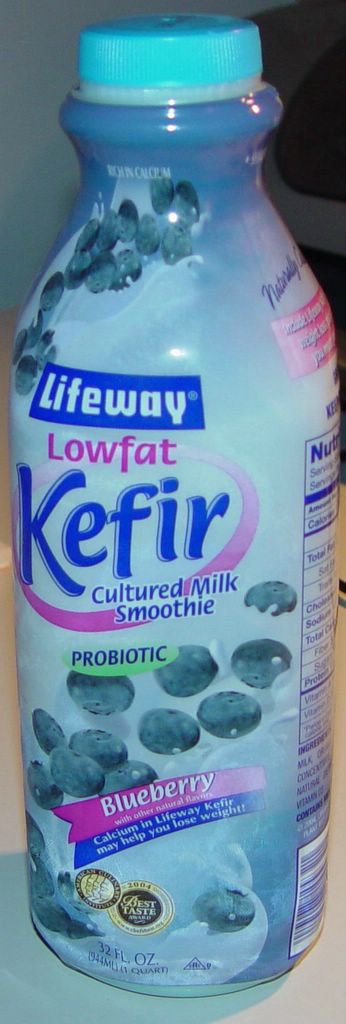
I just found a new really tasty drink. It's called Kefir and has supposedly been around for 2000 years. It has its origins in the Caucasus Mountains in Europe. It is basically a liquid yogurt - at least that's what it tastes like, but it's packed with protein - 14 grams in a single cup - almost twice as much as the equivalent amount of milk. The only creepy thing about it is the blueberry flavored one looks like Head-and-Shoulders shampoo. But, it tastes really really good. Try it!
Monday, November 07, 2005
Don't depend on others for your happiness
(OK, this is probably going to be the most personal post I have made so far. I'm not writing this for sympathy. It is more for self-exploration, and I figure if someone else can learn something useful in it, so much the better.)
About three and a half years ago, I had the most devastating emotional experience of my life. I was engaged to be married and it all suddenly came to an end. Obviously there are always two sides to every story, so I am not even going to attempt to lay the blame on someone else. The point is, the end of that relationship had a severe impact on me. It took me at least a year to get back to a somewhat normal emotional state. What I finally realized while I was coming to terms with this loss was I had been depending on someone else for my happiness rather than just being happy by myself. For the past 3 years or so since then, I've been trying to remember that lesson and just be happy on my own. I haven't even attempted to date anyone for the past 3 years. Instead, I have tried to just spend time with friends, enjoying their company.
Unfortunately, what I am beginning to realize is I am now having the same problem of depending on others for my happiness, but perhaps on a somewhat smaller scale. Even with my friends I tend to become too attached or needy and find on the days my friends are not available, I tend to get a bit melancholy. And then with my closest friends - those who mean the most to me - I tend to be totally insecure about their friendships. I am frequently thinking that I'll eventually do something annoying to drive these close friends away. So, I am always expecting the end of the friendship, reading into anything that might hint that I am wearing out my welcome. (It's a pretty stressful way to live, I must admit. And it makes me realize I am still depending on others for my happiness.)
Sometimes I wish I was the type of person that has so much confidence in themselves that I wouldn't care what other people think, that if it turns out a friend doesn't like me anymore and doesn't like something I've done, that's the friend's problem, not my own. But that's not really who I am. I am trying to always improve my character, and one of the ways I work on that is through feedback from the opinions of people I respect - i.e. my closest friends. It's not that I will do things that I don't philosophically agree with just for acceptance from my friends (I wouldn't choose them as friends in the first place if we didn't share the same values), but it's a more subtle thing. If it seems something I have done is bothering someone, I'll try to figure out what that might be and how I might avoid it in the future. But, it still seems to get back to the point that I am depending on others for my happiness. If I don't feel "accepted" by those who mean the most to me, then I end up an emotional wreck trying to figure out what I might have done wrong.
What I really need is a better way to measure my self-worth on my own rather than depending on others. At least, that's what I'm thinking right now. But, I can't live life in isolation. The interaction with people is what life is all about. I just wish I didn't get so attached to people. It reminds me of a Buddist quote: "He who loves 50 people has fifty woes. He who loves no one has no woes." But is the point of that that you shouldn't love anyone, or is it more that you should just expect to have some suffering since there will be people in your life who you will love?
Hmmmm.... I must think on this some more. In the meantime, I'll just have to get used to feeling like an emotional wreck at times. Gah!
About three and a half years ago, I had the most devastating emotional experience of my life. I was engaged to be married and it all suddenly came to an end. Obviously there are always two sides to every story, so I am not even going to attempt to lay the blame on someone else. The point is, the end of that relationship had a severe impact on me. It took me at least a year to get back to a somewhat normal emotional state. What I finally realized while I was coming to terms with this loss was I had been depending on someone else for my happiness rather than just being happy by myself. For the past 3 years or so since then, I've been trying to remember that lesson and just be happy on my own. I haven't even attempted to date anyone for the past 3 years. Instead, I have tried to just spend time with friends, enjoying their company.
Unfortunately, what I am beginning to realize is I am now having the same problem of depending on others for my happiness, but perhaps on a somewhat smaller scale. Even with my friends I tend to become too attached or needy and find on the days my friends are not available, I tend to get a bit melancholy. And then with my closest friends - those who mean the most to me - I tend to be totally insecure about their friendships. I am frequently thinking that I'll eventually do something annoying to drive these close friends away. So, I am always expecting the end of the friendship, reading into anything that might hint that I am wearing out my welcome. (It's a pretty stressful way to live, I must admit. And it makes me realize I am still depending on others for my happiness.)
Sometimes I wish I was the type of person that has so much confidence in themselves that I wouldn't care what other people think, that if it turns out a friend doesn't like me anymore and doesn't like something I've done, that's the friend's problem, not my own. But that's not really who I am. I am trying to always improve my character, and one of the ways I work on that is through feedback from the opinions of people I respect - i.e. my closest friends. It's not that I will do things that I don't philosophically agree with just for acceptance from my friends (I wouldn't choose them as friends in the first place if we didn't share the same values), but it's a more subtle thing. If it seems something I have done is bothering someone, I'll try to figure out what that might be and how I might avoid it in the future. But, it still seems to get back to the point that I am depending on others for my happiness. If I don't feel "accepted" by those who mean the most to me, then I end up an emotional wreck trying to figure out what I might have done wrong.
What I really need is a better way to measure my self-worth on my own rather than depending on others. At least, that's what I'm thinking right now. But, I can't live life in isolation. The interaction with people is what life is all about. I just wish I didn't get so attached to people. It reminds me of a Buddist quote: "He who loves 50 people has fifty woes. He who loves no one has no woes." But is the point of that that you shouldn't love anyone, or is it more that you should just expect to have some suffering since there will be people in your life who you will love?
Hmmmm.... I must think on this some more. In the meantime, I'll just have to get used to feeling like an emotional wreck at times. Gah!
Sunday, November 06, 2005
Blackstone River: 2 Me:0
A little more than ten years ago a friend of mine planned a canoe day-trip down the Blackstone River. We started early in the morning and expected to finish around mid-day, so we didn't pack a lunch and just brought along a few snacks. As it turned out, due to the condition of the river (it was very low at spots and we ended up having to drag the canoe through the shallow water in many spots) we totally underestimated how long it would take to get from our starting location to our finish. As the day progressed and it became late afternoon, we realized we were still miles from our final destination. Fortunately, at one section of the river we ended up coming across some firefighters who were practicing with a boat. When they heard where we were headed and how much further we had to go, they offered to throw our canoe into a pickup truck and they drove us a lot closer to where we needed to be. Fortunately, we then ended up getting back to our car before nightfall and it all turned out ok.
Yesterday, some friends of mine decided to plan a trip down the Blackstone River - there were eight of us in total. Since it was an afternoon trip and we knew we only had a few hours of daylight, the person who knew the river well picked a short route. So, around 2:00 we set off down the river.
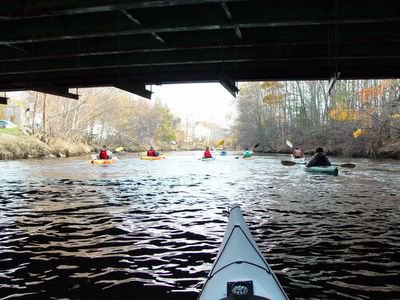
It turned out to be a very fun adventure, but it was not at all what we expected. Due to the recent heavy rainfall last month and the near flood conditions a few weeks ago, many sections of the river were obstructed with fallen trees. This made progress very slow as we had to either get out and drag the kayaks on land to go around, or carefully navigate through small openings in the river.

The first fallen tree we encountered was very easy to go under, but I decided it might be fun to hang onto the trunk as I passed under it. That was a very bad idea. By grabbing onto the trunk I made myself totally off-balance. While my upper body stopped moving, my kayak continued to be pushed by the river current and I quickly found myself in my kayak floating upside-down down the river. Gah! How embarasssing! Fortunately, it was a warm sunny day, the water wasn't too cold, and I was wearing clothes that were designed to dry quickly (i.e all synthetics, no cotton). So, after emptying my kayak of water, it wasn't at all uncomfortable being wet.
As we continued down the river, the conditions seemed to worsen and sections became more and more difficult to navigate. Two more people flipped their kayaks (a couple times each) while trying to get around obstacles in the river, and our progress was getting quite slow. Even though a few of us were now wet, and one person had lost their jacket, mobile phone, and pair of sneakers in the river, everyone was still having a lot of fun and spirits were high. (Plus, we had some dry clothes in reserve if someone needed them.) The main concern was how much further we had to go and how much daylight was left.
As it started to get dark we encountered another obstructed section of river and one more person flipped their kayak. Another person (who had already fallen in several times earlier) tried to help the first person but ended up flipping his kayak as well. To make matters worse, his paddle also snapped in half during the ordeal and we could only find half of it. At this point we decided it would not be wise to continue down the river in the dark. The section of river we were on is part of the Blackstown River Park and there is a hiking trail that runs along the river bank. We knew this trail would come out where we parked some of our cars, so we began the journey of hiking down the trail carrying a bunch of kayaks. Fortunately, some of us had headlamps and flashlights, so we could see while hiking down the trail. I had also brought my GPS, so we had an idea of how much further we had to hike.
This picture shows some of us taking a break after hiking up a hill with the kayaks. It's a pretty funny scene with some sea kayaks in the middle of the woods, in the dark, with no water anywhere in sight.
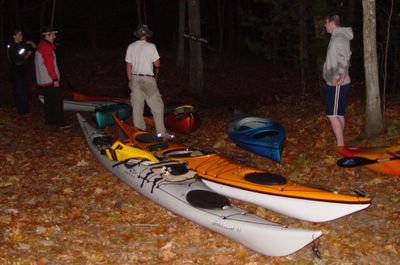
As it turned out, we had to hike a little more than a mile to get back to the cars.
So, after two trips down the Blackstone River, neither time have I actually completed it in the water. Blackstone River:2 Me:0
Lessons learned:
Pack extra food and water In my first trip down the river ten years ago, I made the mistake of not packing enough food. It was assumed the trip would last a set amount of time and we hadn't planned for the unexpected. This time I learned from that and packed some extra snacks and extra water. (Also some of the other people in the group did the same.) As we never even expected to be hiking through the woods for an hour or so, the extra snacks and water was good to have.
Bring extra paddles When I go kayaking solo in the ocean, I bring an extra paddle with me. You never know what might happen, and being in the ocean with no paddle is a bad thing. Going on a two-hour trip down a fairly tame river, I hadn't even thought of bringing an extra paddle. That was a big mistake on my part. Had we lost one of the paddles earlier on the trip, it would have made our progress even slower. I did bring a tow-rope, but I'm not sure how useful that would have been given the obstacle-strewn condition of the river.
Don't wear cotton This is a mantra for anyone who is serious about hiking or kayaking: "Cotton kills" While warm and comfortable when dry, cotton is awful when wet. It stays wet and saps warmth from the body. You should always wear either wool (stays warm when wet) or synthetics designed to wick the moisture away from your body. Fortunately, we had enough dry clothes for those who fell in, but just barely. Next time I'll definitely pack more backup clothes in the kayak rather than leaving them in the car.
Plan for the unexpected This is something a hiking friend of mine has always told me when going on hikes. Bring more than you expect to need. Plan for the worst case scenario. You can take this to an extreme and end up totally bogged down with too much gear, but it is good advice. And unlike with hiking, having extra gear in a kayak isn't that big of a deal. It's not like you'll be carrying the kayak down a hiking trail for a mile or so. Or will you?
Yesterday, some friends of mine decided to plan a trip down the Blackstone River - there were eight of us in total. Since it was an afternoon trip and we knew we only had a few hours of daylight, the person who knew the river well picked a short route. So, around 2:00 we set off down the river.

It turned out to be a very fun adventure, but it was not at all what we expected. Due to the recent heavy rainfall last month and the near flood conditions a few weeks ago, many sections of the river were obstructed with fallen trees. This made progress very slow as we had to either get out and drag the kayaks on land to go around, or carefully navigate through small openings in the river.

The first fallen tree we encountered was very easy to go under, but I decided it might be fun to hang onto the trunk as I passed under it. That was a very bad idea. By grabbing onto the trunk I made myself totally off-balance. While my upper body stopped moving, my kayak continued to be pushed by the river current and I quickly found myself in my kayak floating upside-down down the river. Gah! How embarasssing! Fortunately, it was a warm sunny day, the water wasn't too cold, and I was wearing clothes that were designed to dry quickly (i.e all synthetics, no cotton). So, after emptying my kayak of water, it wasn't at all uncomfortable being wet.
As we continued down the river, the conditions seemed to worsen and sections became more and more difficult to navigate. Two more people flipped their kayaks (a couple times each) while trying to get around obstacles in the river, and our progress was getting quite slow. Even though a few of us were now wet, and one person had lost their jacket, mobile phone, and pair of sneakers in the river, everyone was still having a lot of fun and spirits were high. (Plus, we had some dry clothes in reserve if someone needed them.) The main concern was how much further we had to go and how much daylight was left.
As it started to get dark we encountered another obstructed section of river and one more person flipped their kayak. Another person (who had already fallen in several times earlier) tried to help the first person but ended up flipping his kayak as well. To make matters worse, his paddle also snapped in half during the ordeal and we could only find half of it. At this point we decided it would not be wise to continue down the river in the dark. The section of river we were on is part of the Blackstown River Park and there is a hiking trail that runs along the river bank. We knew this trail would come out where we parked some of our cars, so we began the journey of hiking down the trail carrying a bunch of kayaks. Fortunately, some of us had headlamps and flashlights, so we could see while hiking down the trail. I had also brought my GPS, so we had an idea of how much further we had to hike.
This picture shows some of us taking a break after hiking up a hill with the kayaks. It's a pretty funny scene with some sea kayaks in the middle of the woods, in the dark, with no water anywhere in sight.
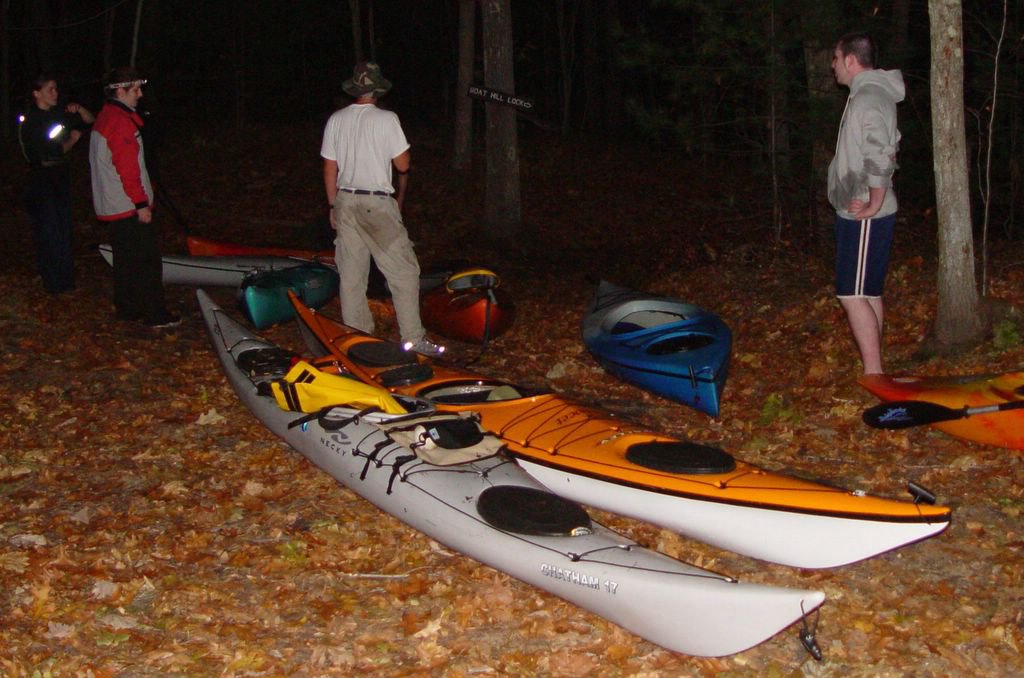
As it turned out, we had to hike a little more than a mile to get back to the cars.
So, after two trips down the Blackstone River, neither time have I actually completed it in the water. Blackstone River:2 Me:0
Lessons learned:
Pack extra food and water In my first trip down the river ten years ago, I made the mistake of not packing enough food. It was assumed the trip would last a set amount of time and we hadn't planned for the unexpected. This time I learned from that and packed some extra snacks and extra water. (Also some of the other people in the group did the same.) As we never even expected to be hiking through the woods for an hour or so, the extra snacks and water was good to have.
Bring extra paddles When I go kayaking solo in the ocean, I bring an extra paddle with me. You never know what might happen, and being in the ocean with no paddle is a bad thing. Going on a two-hour trip down a fairly tame river, I hadn't even thought of bringing an extra paddle. That was a big mistake on my part. Had we lost one of the paddles earlier on the trip, it would have made our progress even slower. I did bring a tow-rope, but I'm not sure how useful that would have been given the obstacle-strewn condition of the river.
Don't wear cotton This is a mantra for anyone who is serious about hiking or kayaking: "Cotton kills" While warm and comfortable when dry, cotton is awful when wet. It stays wet and saps warmth from the body. You should always wear either wool (stays warm when wet) or synthetics designed to wick the moisture away from your body. Fortunately, we had enough dry clothes for those who fell in, but just barely. Next time I'll definitely pack more backup clothes in the kayak rather than leaving them in the car.
Plan for the unexpected This is something a hiking friend of mine has always told me when going on hikes. Bring more than you expect to need. Plan for the worst case scenario. You can take this to an extreme and end up totally bogged down with too much gear, but it is good advice. And unlike with hiking, having extra gear in a kayak isn't that big of a deal. It's not like you'll be carrying the kayak down a hiking trail for a mile or so. Or will you?
Thursday, November 03, 2005
A Fine Example of Plagiarism?
I was reading a recenty published article today at work that came from a technical magazine, and it started with a quote from Socrates that I found very interesting. Here is the quote "The discovery of the alphabet will create forgetfulness in the learners' souls, because they will not use their memories; they will trust to the external characters and not remember of themselves." I thought it was an interesting idea that learning to read and write might be considered a bad thing because you don't have to exercise your mind as much for trying to remember things. It sort of also reminded me of the advent of the calculator and how people say it is also a bad thing because people no longer do math in their head.
So, since I found the quote interesting, I was thinking of writing about it here in my blog. But, since the quote came from a technical computer article, I wanted to verify its authenticity. So, I did a quick Google search on the quote and came up with a very surprising result. Only one result was returned for the search and this led to an article written in 1998 for the Honolulu Star-Bulletin. As I started to read this article, I made a very shocking discovery. The first half of the article from the technical magazine was word-for-word taken from this article from 1998! Check for yourself - here are the links to the two articles:
The original from 1998
The "copy" from 2005
NOTE: I contacted the editor of the magazine and author of the suspect article and did hear back from him. He claims it was an accident - he often saves links to articles he finds interesting and in this case he thinks he must have accidentally saved the text of the article a long time ago. Then, more recently he came across this saved text and thought it was something he had written. At least, that's his story. He said he will be
updating the article to correct this mistake. (In fact, the article has now been corrected. For historical purposes, I saved a copy of the original "bad" article to demonstrate the similarity between the two pieces.) In any case, even if what the author states is true and it was an honest mistake (and I tend to try to always think the best of people), it was very very careless work. An author should be especialy sensitive to issues of plagiarism and should not carelessly copy-and-paste an article's text for future reference without saving the information about where it came from.
So, since I found the quote interesting, I was thinking of writing about it here in my blog. But, since the quote came from a technical computer article, I wanted to verify its authenticity. So, I did a quick Google search on the quote and came up with a very surprising result. Only one result was returned for the search and this led to an article written in 1998 for the Honolulu Star-Bulletin. As I started to read this article, I made a very shocking discovery. The first half of the article from the technical magazine was word-for-word taken from this article from 1998! Check for yourself - here are the links to the two articles:
The original from 1998
The "copy" from 2005
NOTE: I contacted the editor of the magazine and author of the suspect article and did hear back from him. He claims it was an accident - he often saves links to articles he finds interesting and in this case he thinks he must have accidentally saved the text of the article a long time ago. Then, more recently he came across this saved text and thought it was something he had written. At least, that's his story. He said he will be
updating the article to correct this mistake. (In fact, the article has now been corrected. For historical purposes, I saved a copy of the original "bad" article to demonstrate the similarity between the two pieces.) In any case, even if what the author states is true and it was an honest mistake (and I tend to try to always think the best of people), it was very very careless work. An author should be especialy sensitive to issues of plagiarism and should not carelessly copy-and-paste an article's text for future reference without saving the information about where it came from.
Subscribe to:
Posts (Atom)